


We’re forced to share little parcels of visibility onto each other, constantly.
Wrap emails. Showcase presentations. Opinions in meetings not because they add anything, but because speaking is its own form of being seen.
We have to. We know visibility works and invisibility doesn’t.
The more parcels we push, the noisier it all gets, so the more we share. And collectively we’re just making each other busier.
This is partly why a lot of us hate it. It’s all a bit samey. A bit desperate.
But there’s a better way to think about it.
Visibility has two layers
Most advice assumes your problem lies only in your communication. But visibility has two layers:
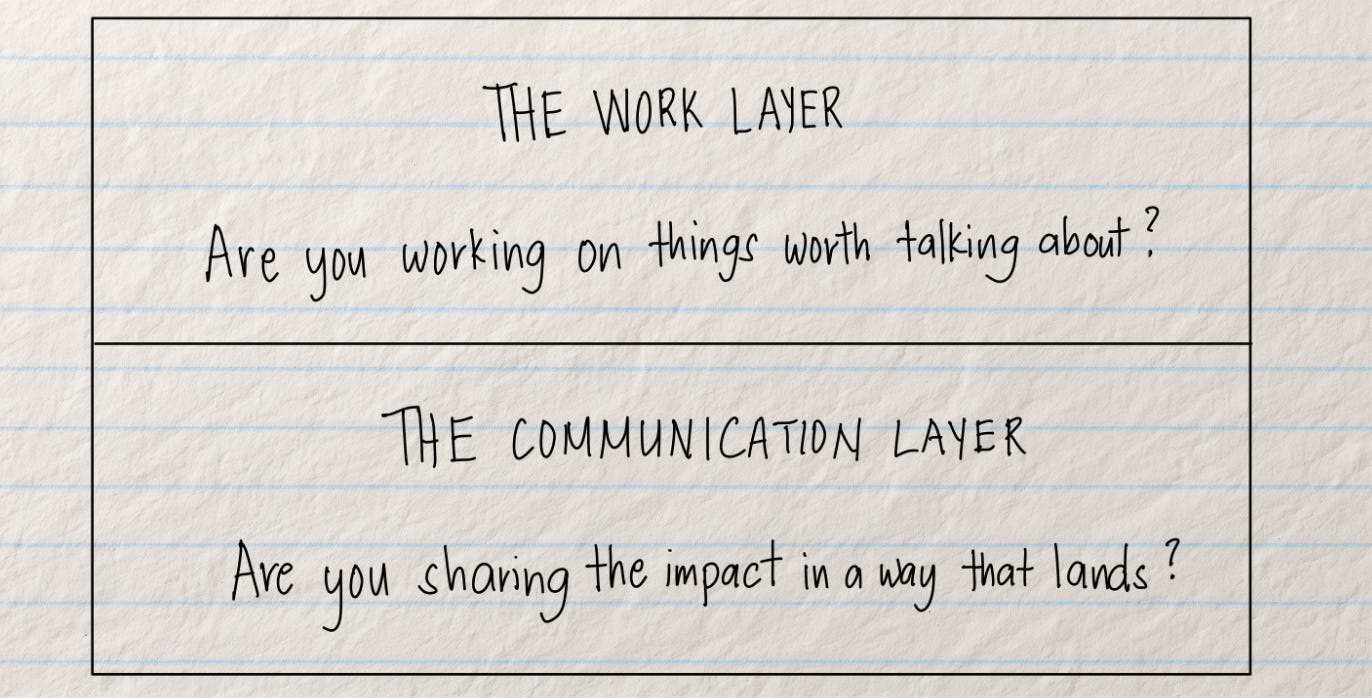
The work layer: Are you working on things worth talking about?
The communication layer: Are you sharing the impact in a way that lands?
If you don’t believe you’re doing impactful work, it’s harder to want to talk about it. You can’t polish a turd.
So let’s start there.
The Work Layer: Are you working on things worth talking about?
You’ll hear:
Be explicit with your manager. Tell them:
“I want to get exposure to X”. ”How can I be involved in Y”.
It’s not bad advice, but it can backfire early-career. There’s a whole archetype of the ambitious junior who chases big shiny things but neglects the grunt work. You don’t want that reputation.

You earn the interesting work by doing your core work reliably first.
I feel like you get that.
So, here are 4 other things that help.
1. Be dialed in to problems
Pay attention to what keeps coming up. What’s the org struggling with? What does your manager return to in 1:1s? What are senior leaders repeatedly bringing up? This is about awareness beyond your level. It gives you context. It doesn’t mean you go solve those problems. It means you understand why certain things matter, so your work isn’t disconnected from reality.
About once a quarter, helps to ask your manager:
✅ "What do you see as the biggest problem our team is trying to solve right now?"
You’re not always working on the biggest problem but talking to your manager about it elevates you to a thought partner who thinks at their level.
2. Have smart prioritisation conversations
In my experience, the priority list we set at the start of the quarter was rarely the exact same as what mattered by the end. Your manager doesn’t want you working on unimportant things but companies are chaotic and if you’re not proactive, it’ll happen. The move is to bring your current priorities to your manager and invite them to react - not wait for them to redirect you.
✅ Here are my top 3 priorities right now. Does that still feel right given what’s changed?
When something new lands - which it will - name the trade-off rather than just absorbing it:
✅ I can take that on. That means X moves to next month. Is that the right call?
Managing priorities well, can open you up to new opportunities:
✅ I’ve been noticing X getting a lot of attention. I had an idea for where I can help - can I run it past you?
3. Do unglamorous but high-visibility work
The question isn’t whether the work itself sounds impressive. It’s whether it puts you close to people who matter. Proximity to decision-makers. High stakes for someone senior. Cross-functional exposure.
For example:
No one wanted to work on B2B events at Google. Not when there were Pixel campaigns with multi-million dollar budgets and celebrity activations.
I always died a little inside when I got tapped for another one. But every time - briefing meetings, sitting in rehearsal rooms jamming on speeches, helping leaders feel prepped and look good on stage - those projects put me in rooms with people I wouldn’t have been in otherwise.

The events I never wanted to do were the ones that got me promoted.
Look for things like:
Prepping briefing notes or talking points for leadership
The weekly report that goes to all XFN stakeholders
Anything with an external moment - a client presentation, a panel, a keynote
The schedule & briefing pack for an exec site visit
Analysis a senior leader relies on to make decisions
Supporting a launch in a smaller but important market
Big problems that need urgent fixes
4. Attach yourself to something big, even in a small way
What’s the smallest piece of a high-profile project that makes sense for you to own?
For example:
In 2011, the only thing anyone was talking about at work was Google+ (lol). I worked in Ads marketing, which had nothing to do with it. I pitched a tiny piece to own - partnering with a radio station to do video “hangouts” with artists they already had in the studio. We only did two of them. But the idea got picked up by the CMO and shared at a global all-hands and became one of the highest visibility moments of my early career.

Good work that nobody knows about is just... work.
Which brings us to Part 2.
The Communication Layer: Are you sharing the impact in a way that lands?
This is about context. Helping decision-makers connect your effort to company performance. Specific tactics coming in Part 2 - see you in a couple of weeks.
Love Soph ✌🏼
PS - I wrote this Substack with my voice using this dictation tool I’m in love with. As a three-finger typer it genuinely changed my life (affiliate link, but I’d still recommend it to you even if it wasn’t).
This is so spot on! Unglamorous work also has the benefit of being low-competition. If everyone else is chasing the shiny thing, it's much easier to do the grunt work unencumbered. Bonus points if you turn the boring work into the next shiny thing.
Point 3 is so on point 😇
The unglamorous is usually lower effort that most people think but gets great viability if done right