


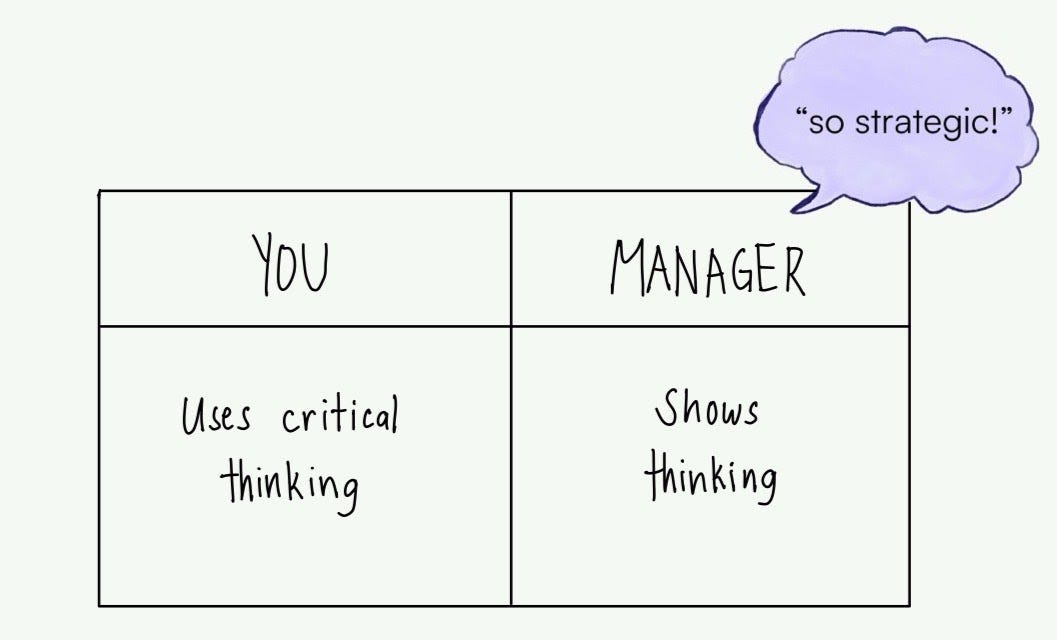
You’re planning your one big summer trip for the year.
Friend of a friend says: “Albanian Riviera. Go there.”
WDYT? Are you ready to drop $5k and book? How confident are you?
-
Imagine instead they say:
“Assuming you want water because… summer, and 10 days max because… job. Based on these criteria: insane beaches, good food/culture, under $100/day - Albanian Riviera hits all three plus it’s blowing up on 2026 trend lists (might get overrun soon). Trade-off: no direct flights which sucks but you do get layover in Rome…”
Now we’re talking.

Show your working
I’m oversimplifying to make a point but:
Early-career: “What should we do?”
Levelling up: “Here’s what I recommend we should do”
Managers approve big, potentially costly decisions all day (like you deciding where to spend your only summer holiday). They need to feel confident in your judgment.
The easiest way to build that confidence (especially when you’re newer)?
Show your working.
When you base decisions on clear criteria instead of gut feel or personal preference, you demonstrate critical thinking.
And that’s what makes them see you as strategic.
There are different ways to “show your working” - these aren’t steps, more like options. Pick 1-2 that work for your scenario.
1. Share your assumptions
Fastest way to catch any misalignment up front.
Example:
✅ You: “I’m working with the assumption they need to pull the numbers daily, so recommend a live dashboard. I’ll walk you through the plan. Time to build: 3 weeks.”
Your Manager: “Oh they don’t need numbers daily. A monthly email is fine.”
You: 😅
Different assumptions = wildly different conclusions. If your manager can actually unlock more budget, or if timing is tighter than you thought, you might suggest a completely different option.
2. Show what you considered (and cut)
I love this one. Surprisingly effective for how easy it is. Show what else you looked at and why you ruled it out.
Example:
🚫 “We should build in-house”
✅ “We should build in-house. To get to that recommendation I looked at three different approaches:
Option A (outsource completely) - ruled out because we’d lose control over quality
Option B (build in-house) - my recommendation because it gives us flexibility long-term
Option C (hybrid) - interesting but adds too much coordination overhead for our team size”
3. Use a decision matrix
For bigger decisions where you’re comparing multiple options, try a decision matrix. These are good because they break down the attributes you’re evaluating, in a single snapshot. You can condense 3 weeks of critical thinking into 30 seconds for your leader!
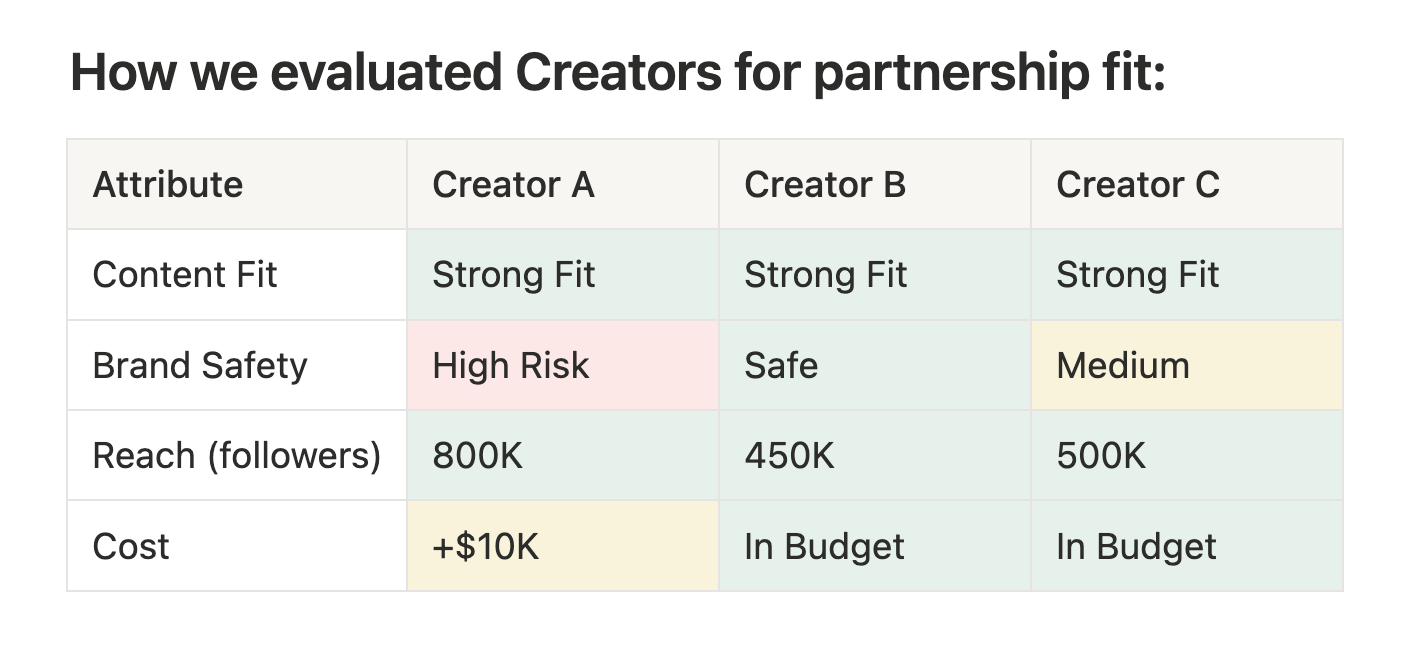
✅ “My strong recommendation is Creator B.
As you can see:
All Creators are a good content fit for us. I’m optimising for Brand Safety, which we agreed is more important than Reach right now. Creator A: most reach, but risky. Creator B hits the mark. Let me know if brand safety isn’t actually such an problem though.”
Common attributes to optimise for:
Speed/timeline
Cost/budget
Quality/performance
Team capacity/complexity
Risk level/brand safety
Long-term flexibility
4. Present the downsides
Show you’ve thought through the risks, trade-offs, and unknowns.
Example:
✅ “Main risk is that Tool A takes a month longer for team training, but it saves us $20K/year toward our budget goal.”
✅ “The one thing I haven’t validated yet is whether it can pull the social data. Will ask Max in Analytics this week - any other suggestions?”
It builds trust because it shows honesty and that you’re thinking ahead.
5. Explain the ‘why’
Sometimes it’s as simple as just laying out your rationale - the why - in a few bullets, using data and evidence as much as you can.
Example:
✅ “My recommendation is we launch without the bonus offer.
Here’s how I got there:
Last quarter’s A/B test: only 3% lift, not worth the margin hit
Pricing research shows bonuses signal desperation
Easier to add one on later, than pull one back.”
Keen to hear your perspective too - is this aligned with what you’ve seen?
Why “showing your working” works
You’re reducing your manager’s decision fatigue while sharpening your own critical thinking process. People start trusting you more because you’ve shown them you:
Solve the right problem
Consider multiple angles
Are honest about downsides
Don’t hide what you don’t know
There’s a lot more to strategic influence - understanding what matters to different people, asking pre-align questions, using social proof. We’ll dig into those soon.
Love Soph ✌🏼
PS - I wrote this Substack with my voice using this dictation tool I’m in love with. As a three-finger typer it genuinely changed my life (affiliate link, but I’d still recommend it to you even if it wasn’t).
Girl, you simplified this perfectly into actions! I love your examples!
This is great. I was thinking about this from the other perspective as far as showing up when people show their work so that they feel like you give a shit. With this in mind, it further reiterates that understanding how we got there can matter just as much as where we end up. This is especially true when trying to jam the venn diagrams together to seek out common ground. Appreciate the insight and perspective!