


You can be a superstar and still be scoring own goals. What undermines talented people isn’t the quality of their work. It’s the unintentional behaviours they don’t realise they’re doing.
I’ve worked with many hundreds of young people across a 15-yr tech career and these are the top things I saw hurt the reputation of high-performers.
Some of them I’ve done myself, and mannn I wish someone told me earlier. They’re not character flaws. They’re blindspots, and they can be fast to fix once someone explains them.
How you respond to not getting promoted
Main-character energy
The Big Reveal and Ugly Baby
Over-explaining and filling every silence
The Genius Trap
Being a magpie but neglecting core job
Gossip
And a bonus for a very 2026 problem:
Passing AI slop off as your own thinking
1. How you respond to not getting promoted
What makes this hard for top performers is that the signals sometimes hint towards a yes. You’ve done everything right, over-delivered, informal conversations trend the right way. Then the promo doesn’t come. It’s confusing.
I’ve watched people react badly, feel like they’re not valued, sometimes quit.
But there are invisible forces and a system at play that no one really explains. Budgets and forced bell curves. Every manager has a star performer they’re trying to push to the front. A “no” often means “not this round,” not “you’re not good enough.”
On the flipside, I’ve watched people take the “no” with grace, which signalled maturity to Leadership, which then strengthened the case to get them promoted faster next round.
Credibility builder
Use the moment to show you think like a business owner. Respond, don’t react.
✅ “I’m disappointed, but I understand there are business reasons. Can we map out where the gap was, what I need to do, and what else has to happen for this to be a yes next round?”
2. Giving your project main-character energy
This is when you take the initiative you’re leading seriously (a good thing) but start acting like it’s the most important thing in the building. High agency without reading the room.
How it plays out: fake urgency on your own timelines, being too pushy, railroading people instead of letting them contribute, not thinking through the costs your asks put on other teams.
It’s not just junior people who get caught by this. Our marketing director at Google once shared her own performance review feedback with the team: too focused on the country agenda, not enough consideration of regional/global priorities. Too much main-character energy for our team! She fixed it and got promoted to senior director in the next round.

Credibility builder
Managing relationships and competing priorities isn’t an annoying part of the job, it is the job.
✅ Use D/I/N to map who you need to ‘bring on the journey’. Decide: decision maker(s). Inform: people who need deeper input. Notify: people who just need to be across it.
✅ Forward plan your asks: “Here’s what we’re aiming for and how it connects to [your team/company goal]. To get this done by [date], we’d need support from you/your team. Where does this fit on your priority radar right now? Here’s what the ask looks like ___.”
3. The Big Reveal and Ugly Baby
The Big Reveal is surprising your manager with a finished piece of work or idea you spent a lot of time on, without checking it’s right or even wanted in the first place. Managers generally hate surprises and they love drafts.
Ugly Baby is the opposite instinct with the same result. The worse something’s going, the less you want to share it. You hold your ugly baby tighter, trying to fix it alone.
I remember my first ugly baby. A brief I didn’t really understand, slides I showed no-one. I bombed that presentation with such spectacular force it’s burned into a core memory. Share the work you’re most worried about, not just the work that’s going well. Never present slides on a giant screen to a room of people when you’re the only one who’s seen them.
Credibility builder
✅ Share drafts early. At Google some teams had a culture around “the shitty first draft” and people would literally put “SFD” at the top of docs.
✅ Give your manager things to react to: “Here’s two directions I could take this, A and B. Which is stronger?”
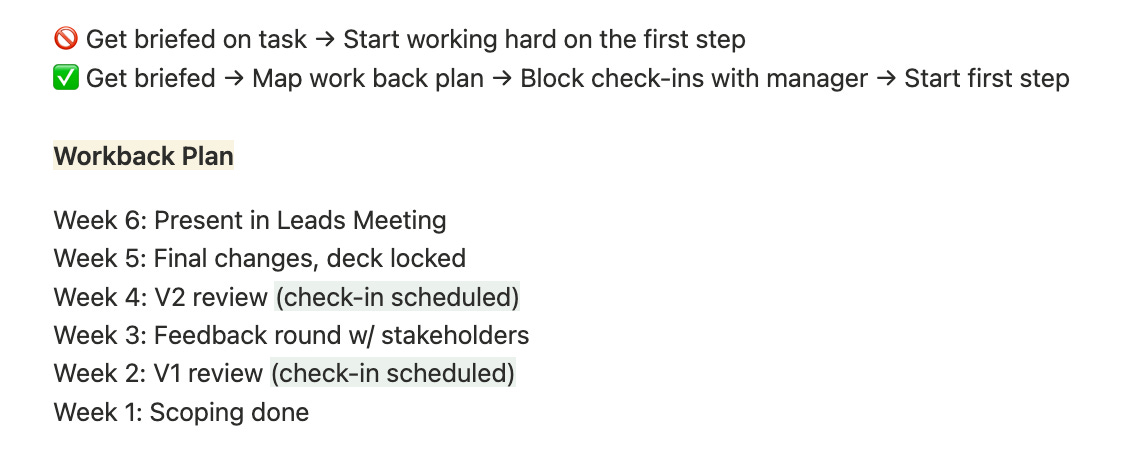
Use workback plans:
4. Over-explaining and filling every silence
Don’t let anyone tell you that this is easy! Speaking concisely, pausing, sitting with silence… it’s DECEPTIVELY hard and takes so much practice. Which is why senior people are better at it.
Things we do that undermine:
Long-winded answers
Giving details chronologically
Not pausing to take signals
Uptalk, fidgeting, not enough eye contact
Credibility builder
✅ Answer short. Offer to elaborate. ”Yes the date moved to May 8. I can give detail on why it moved and the other options we explored if that’s helpful.”
✅ Start with the bottom line, use signposts. ”First I’ll give the headline and then the context. Headline is ___. Context is ___.”
✅ Train yourself to pause. 1) Use the posture trick - after you talk, sit back in your chair, feet on the floor. Leaning forward primes your brain to talk, sitting back signals you’re done. 2) Practice with friends. Imagine you’re talking in bullet points 3-4 max, then stop.
5. The Genius Trap
Child prodigies almost never become adult prodigies.
At work, getting praised for how much you know sounds like a great thing, but it can create the expectation you need to know everything. A study in the 90s (Dweck & Mueller) found kids praised for being smart avoided challenges and gave up faster after failing than those praised for effort.
I’ve watched this play out as overcorrecting. More emails than the situation needs, jumping to conclusions, fading creativity, kind of losing their own judgement trying to look certain. Weirdly, the pressure to be perfect creates both over AND under-confidence.
Credibility builder
✅ Normalise saying “I don’t know, I can find out.” and “Here’s what I’m good at, here’s something I’m working on.” Don’t lose your growth mindset.
✅ Package things that didn’t work “Here’s what we did, here’s what we learned, here’s what I’d recommend next time.”
6. Being a magpie while neglecting the core job
Magpie: infamous Australian bird known for collecting shiny things (and the childhood trauma of riding your bike in swooping season).

I’ve watched people do this too. Always chasing the hot projects, and getting a bit above the work that feels beneath them.
Not gonna lie, solving A+ problems IS a fast track. But you still have to earn it, and neglecting your core job does the opposite. The one thing you have to be early career is reliable. Deliver your actual job first, then go for bigger/better.
Credibility builder
✅ Ask about big problems. Have proactive priority chats with your manager. Product Manager Alec explains it well:
✅ Or, do the job no one else wants to do.
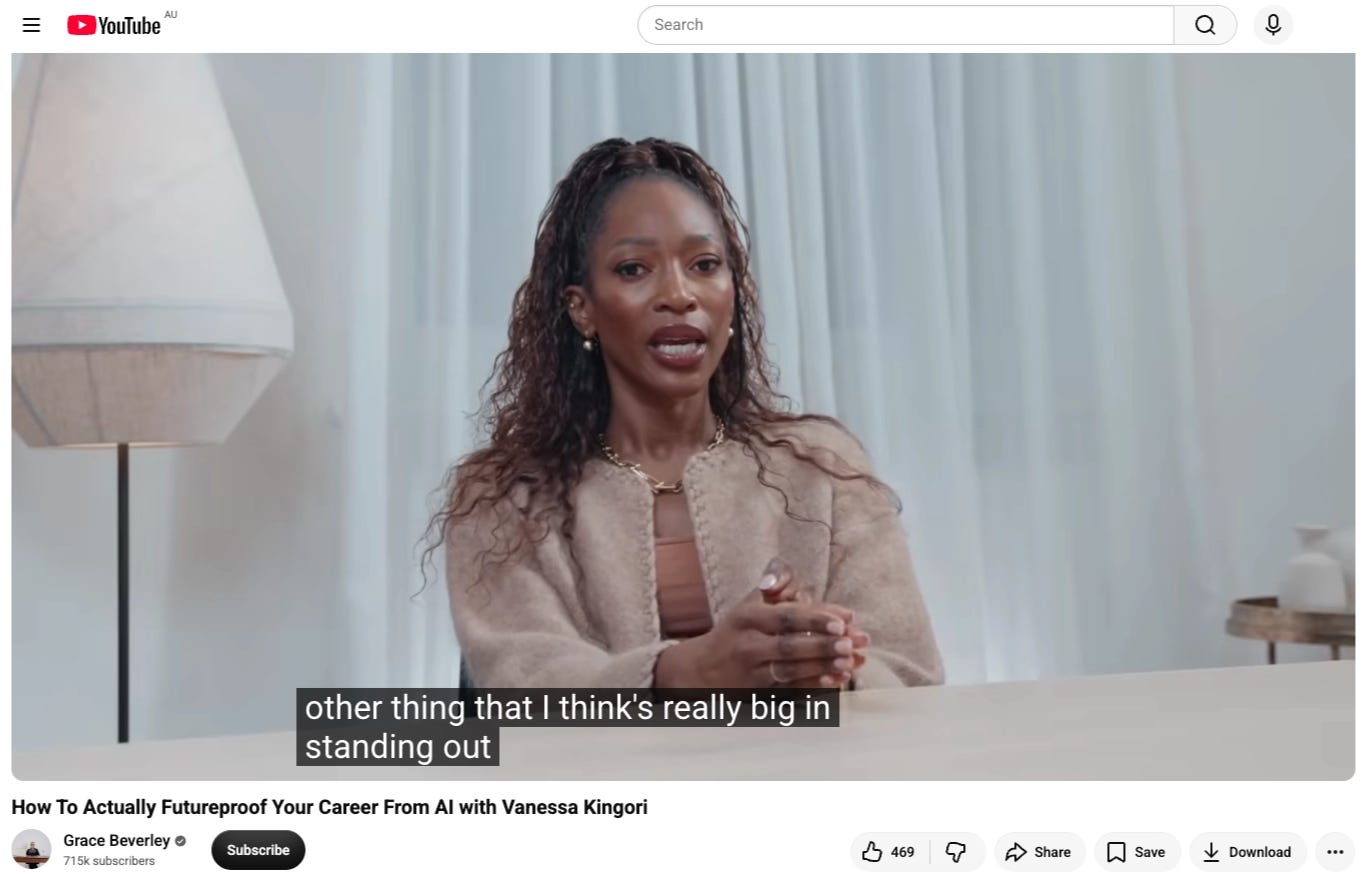
Vanessa Kingori credits this with helping her become the youngest publisher in Condé Nast Britain’s (Vogue/GQ) history:
“Everyone thinks that their career is going to jump forward by being on the shiniest, most visible project. But for bosses, there’s always some stuff that’s left at the bottom that you’re just like ‘oh god, I need to deal with that, I need someone on it’.”
Sometimes you want to be that person.
7. Getting dragged into drama and gossip
Corporate is so funny: senior people are always shocked by the amount of “confidential” things junior levels know, and junior people are shocked by what senior people know about them.
I’ve seen top performers get caught up in workplace drama and take a reputation hit. A lot of shit goes down at work. Some venting is healthy, and some ‘neutral gossip’ is genuinely needed to get things done in big companies. Just watch what you share and who you share it with. Pick one person you trust and use each other as vaults.
Credibility builder
When you need to avoid gossip invitations from co-workers you like ✅ “I love you but I’m going to try and stay out of this one.” ✅ “Oooh, I don’t want to know, tell me something good instead.” ✅ Or just redirect “Gah yeah, so crazy. I actually wanted to ask you about [change the subject].”
8. Passing AI slop off as your own thinking
This is not just early-career people (probably not even the biggest culprits…).
Sending AI written work that you haven’t taken the time to read or change a single word of yourself. We’re all getting too good at spotting it.
Instant trust killer because the receiver has to decide: is this actually what you think or is this what the AI thinks? People still want your brain.
✅ Read what you get back. Question it. Rewrite it in your own words.
Keep overachieving baby 😚
Love Soph x
PS - I wrote this Substack with my voice using this dictation tool I’m in love with. As a three-finger typer it genuinely changed my life (affiliate link, but I’d still recommend it even if I didn’t make a cent).
So good! Wish someone had explained these things to me so much earlier in my career.
This could have been about 3 posts, so many gems in here thank you.
Really great post, thank you! All on the money, especially the first one. Thinking like a business owner is critical to get promoted into snr leadership roles.