



Hiii. This edition is a collab with Alex from Still Wandering. We both care deeply about helping young people make sense of their careers, and as a millennial creating for Gen Z, I love working directly with people in that audience to expand my perspective. Thanks for reading 💙
We know how this sounds.
We know how tired you are of being told to be grateful when rent takes 60% of your salary. We know about the group chats where you screenshot job listings that require five years of experience for entry-level positions. We know you’re sick of boomer LinkedIn posts about how loyalty and hard work got them to the top, when they were hired with a handshake and promoted by just showing up for twenty years.
This isn’t that. We’re trying to make the opposite point.

Gen Z has been dealt an objectively terrible hand. You’re competing against algorithms designed by the smartest engineers in the world whose singular goal is capturing your attention. Scott Galloway points out that for the first time in American history, thirty-year-olds aren’t doing as well economically as their parents were at thirty. In London, the average house price is £523,000 while the median salary is £44,370. Even with a 10% deposit, you’d need to save nearly £9,000 per year just for the deposit alone. After tax, that’s most of your disposable income for six years, assuming prices don’t increase and you can save that much while paying rent.
You’re the guinea pigs for remote work, gig economy precarity, AI replacing entry-level roles and social media destroying privacy during your most formative years.
Previous generations had to deal with one or two of these things. You’re navigating all of them simultaneously while being told you’re entitled for wanting what your parents had by default.
So yes, the hand is shit. Which is exactly why you need more appreciation.
If appreciation is the antidote to resentment and toxicity, and your generation has more reasons for resentment than any recent cohort, then you need more antidote. The maths is simple.
We watched Timm Chiusano’s (excellent) TED talk last week.
His framework helped us see something we’ve been circling around for months while talking to hundreds of people about career confusion. The epidemic of meaninglessness that Gen Z faces at work isn’t just about broken systems or terrible deals. It’s about how you navigate those systems while they’re still broken. Because here’s the uncomfortable truth: you’re going to spend years in jobs that feel hollow while you figure out what you’re building towards.
The previous generation’s deal made this easier to stomach. A linear career at a large corporation came with a pension that would fund retirement, a salary that could buy property, and confidence that thirty years of showing up meant security. When the bargain delivers, appreciation comes more naturally.
Millennials are living through the collapse of that deal while trying to hold Gen Z teams together.
They’re squeezed between their own career uncertainty and upper management demanding results. And Gen Z is entering a system where the deal barely exists at all. The corporate job you take at twenty-five will look completely different in five years, or won’t exist.
And you can see this happening in real time. Previous generations had maybe three or four points of comparison for their careers: immediate family, close friends, possibly neighbours. You have thousands. Every morning you wake up to Instagram stories of people who seem to have figured it out, LinkedIn posts about twenty-three-year-olds launching startups, TikToks explaining how someone made £10k in a month doing something you’ve never heard of.
Professional success operates like beauty. There’s always a perfect version just out of reach, and social media makes sure you see it constantly. But you cannot build a meaningful career waiting for the perfect opportunity to find you.
You’re told to do what you love. Fine. But first, try to learn to love what you do.
Appreciation vs Gratitude
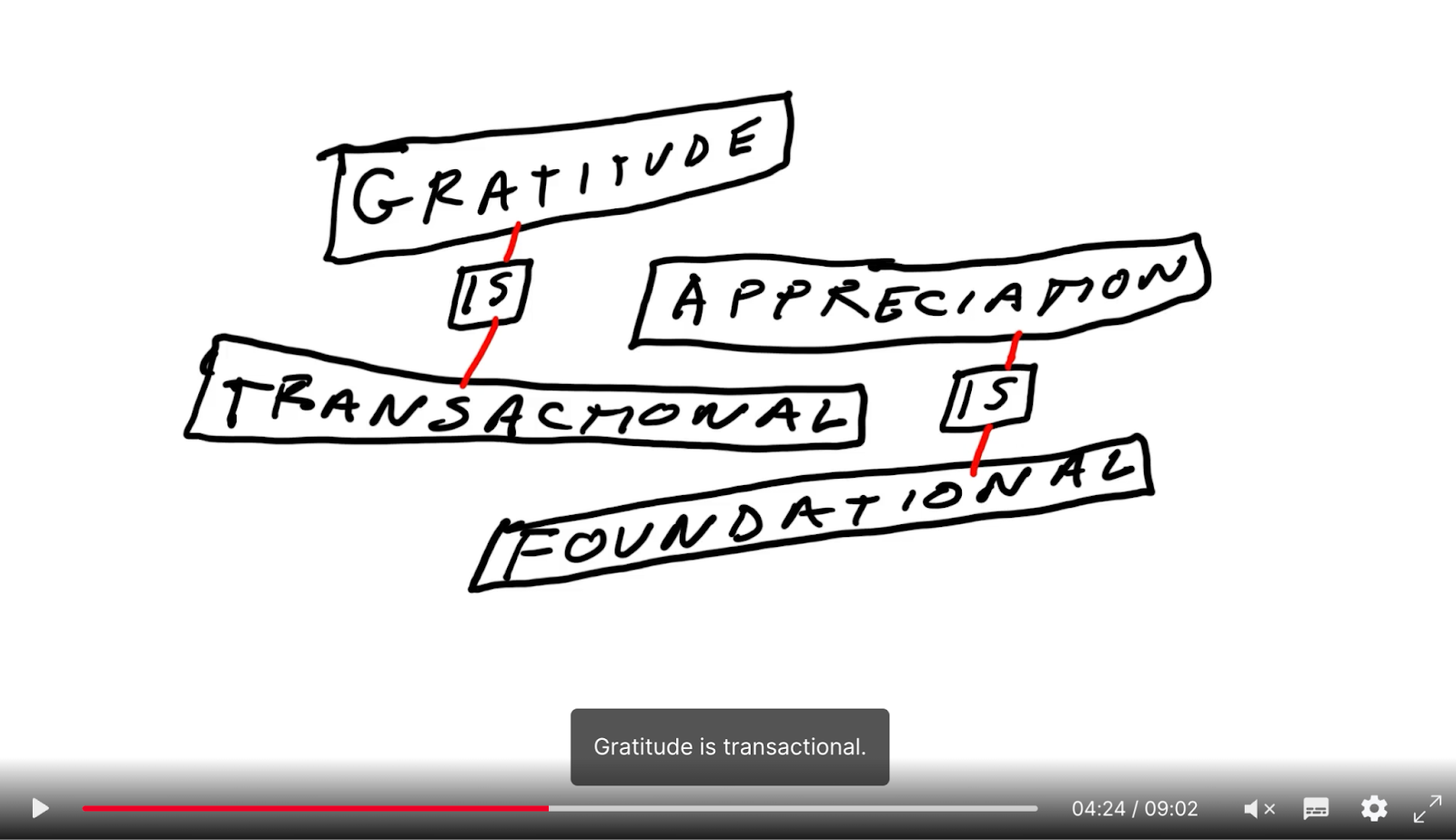
Timm’s framework centres on a distinction that few people recognise: appreciation and gratitude are not the same thing.
Gratitude is transactional. You receive something, then you feel grateful for it. Your manager gives you positive feedback and you’re grateful, you get a bonus and you’re grateful, the company pays for your training course and you’re grateful. The external world has to give you something worth being grateful for before the feeling shows up.
Appreciation works differently. It’s “the act of noticing and valuing the good in our worlds” regardless of what you’re receiving.
In Timm’s case, he’d just endured eight hours of contentious meetings with pending layoffs looming overhead. Walking home late, checking an email from his boss that said “be prepared for tomorrow’s meeting to suck,” he found himself thinking about a manhole cover. Not in some forced gratitude exercise way, but genuinely curious about why manhole covers are circles instead of squares, wondering if they’re made in India. He found something worth noticing even when everything around him was collapsing.
When you’re building a career in a broken system, this distinction becomes critical because most jobs won’t give you much to be grateful for. You’ll spend years in roles that feel meaningless, working for managers who don’t see your potential, in companies that view you as replaceable. Waiting for external validation to fuel you means you’ll be waiting a very long time. Appreciation allows you to find energy and curiosity even when the system around you is demonstrably unfair, which matters when hollow experiences make up most of your twenties.
Why Gen Z needs this more than anyone

The comparison trap has always existed, but Gen Z faces it at a scale that’s truly unprecedented. Previous generations had maybe three or four reference points for what a successful career looked like, while Gen Z has thousands that update hourly in their pocket.
The person launching a startup at twenty-three doesn’t post about the two years they spent learning to code while working retail, and the one making £10k a month doesn’t mention the eighteen months they made nothing. You see the outcome but never the process, which creates a distorted sense of what progress looks like and how long it takes.
Cynicism has become the default posture, partly because it’s safer than admitting you care about something that might not work out. If you’re cynical about everything, nothing can disappoint you, but cynicism also prevents you from extracting value from the experiences you’re having right now.
You’re going to spend years in situations that feel hollow because figuring out what you’re building towards takes time. The question is whether you waste those years being resentful about how unfair it all is, or whether you learn to appreciate your way through them. This is a totally fair pragmatic navigation of a broken system. You didn’t design it and you’re not responsible for fixing it, but you are responsible for deciding how you move through it while you’re building something better.
Training your attention on what’s worth appreciating
So how do you do that exactly? Here’s a list of practical ways to start.

1. The fascinating mess of group dynamics
Your workplace is a live anthropological study of human behaviour. Watch a collection of people attempt to work towards a common goal while also fighting for their own career progression - it’s a fascinating education in power, persuasion, empathy, ethics. The person who talks the most in meetings almost never has the most influence. I (Soph) have learned more about communication from interacting with people at work than from any course. Approach it like you’re taking field notes.
2. Appreciate people when they don’t expect it
If you think someone did something great, take the 20 seconds to tell them. Especially when there’s no reason to. Not “thank you” because they helped you (though you should do that too), but noticing the effort they didn’t have to give. The way they stood up for someone in a meeting or shared learnings on a project that had nothing to do with you. Tell them not just “good job” but specifically why it was good. People assume someone else will tell them but you’d be surprised how rarely they do.
3. Curiosity as your advantage
“What’s their backstory?” is an incredibly useful question to ask yourself when someone frustrates or confuses you. Instead of getting mad, get genuinely curious first (you can still get mad later). Wonder: What else is going on for them? What pressure does their manager has\ve them under? What are they optimizing for that’s different to what I am? Curiosity doesn’t excuse bad behavior, but it helps you manage your response to it. And this is something you can completely control.
It’s for more than just dealing with difficult people too. There’s a clear pattern I (Soph) have observed over two decades: young people who ask questions compulsively, who are desperately curious about others’ experiences and stories - they’re always the ones who end up (1) abnormally successful at a young age and (2) universally loved. True influence comes from being both interested in other people and interesting yourself. Most people try too hard on the latter.
4. Everyone’s too worried about themselves to worry about you
Sounds depressing but it’s actually liberating. No one’s paying that much attention to you because they’re pretty consumed by their own insecurities and pressures. Appreciate this invisibility - it’s permission to experiment without judgment. Did you know your manager might be as nervous in your 1:1 as you are? The presentation you’re stressed about.... half the room is thinking about lunch. Everyone’s performing confidence while feeling uncertain. So you can experiment. Make mistakes. The judgement you feel is mostly in your head.
5. Shared irreverence as a survival tool
The ability to laugh at work’s ridiculousness might be what saves you. Someone says something unintentionally funny in a meeting that gets memed into a team slogan and eventually ends up on laptop stickers. The way you catch your coworker’s eye when someone says “let’s pop that in the parking lot” for the third time in ten minutes. You don’t even know it’s happening at the time, but when you’re retelling stories later, you realise these irreverent moments created the connections that made the whole thing bearable.
6. What your worst experiences teach you
Listen to any leader on a podcast - the stories they tell are always about when things went wrong and how they turned it around. The times you really mess up and want to die in a hole end up being your biggest growth moments, the ones you actually remember decades later. The hardest projects forge the strongest professional friendships. Maybe it’s the trauma bonding - the way you drag each other out of the trenches when no one else is coming to help. Your worst manager is a clear case study in what you never want to become. The real question in all of these moments is: what can I take from this for me?
7. Some things have actually gotten better
We’re trending towards it being uncool to email people on weekends. It’s fairly normalised to take a “personal day” for your mental health. Five years ago, your options were to pretend you’re sick or use annual leave. Now you can tell the truth. You just … need a day. That’s progress we shouldn’t take for granted. Some things are getting better. Not everything. Not fast enough. But some things.
It’s worth noticing.
Appreciation is the skill that lets you hold both truths at once

Gen Z’s cynicism about work is justified. The system is objectively worse than what previous generations had. Appreciation is the skill that lets you hold both truths at once - “this is unfair” and “I can still extract something valuable from it”. The unfairness doesn’t go away, but spending years resenting every moment means you miss the learning, the relationships, the curiosity that could have been building while you were busy being bitter.
When we say you need to learn to love what you do, we don’t mean loving emails and inane hallway chats and forced fun-facts. We mean love what you’re getting from the experience, even while the work itself might feel hollow. The hard work, the mistakes, the bad managers, the meaningless projects… are all feeding into you. What you take out of these experiences shapes you as a person and your career. This is what you can control.
The generation that masters this - staying present enough to notice what’s worth noticing, curious enough to learn from people others write off, grounded enough to find meaning in imperfect conditions - will be the one that changes things. Because change requires enough optimism to believe it’s possible and enough realism to know it won’t be easy.
Love Soph & Alex
What we’re up to
Soph: I’m building a foundational short course for Gen Z: an intentional set of core skills and tools that have a spiral-up effect on your career. Join the waitlist.
Alex: I’m building TrueNorth, an AI coach for navigating career confusion. Not another job matcher, but a tool for understanding yourself first. Early access opens next month. Join the waitlist.
I’ve also been playing around with the idea of building a community for the professionally lost. No networking, no LinkedIn requests, just honest conversations with people who get it. Sign up here if this is something that would interest you.
PS - I wrote this Substack with my voice using this dictation tool I’m in love with. As a three-finger typer it genuinely changed my life (affiliate link, but I’d still recommend it to you even if it wasn’t).
As a millennial, I witnessed that broken system - but let’s also say that belongs to corporate world. Big names on your cv looks fancy, not so fancy to work into. I left the corporate world after 3 miserable years to work in design agencies, startups and then freelance. I didnt find that broken system in these new environment, especially in startups where everybody is young and trying to make a difference. So my advice to younger me would be: choose smaller companies where you feel people are not just a number. Choose people and not the salary. Money comes and goes, but the best experiences I had came from the right people.
YEP YEP YEP!!! Just because something is unfair and a little outdated, it doesn't mean we should set our career on fire in protest