




Regular readers know I rarely do collabs but this was commissioned by Netflix as part of My Brilliant Career: My Way, a series of personal essays inspired by Netflix’s new series My Brilliant Career, now streaming.
I said this was a collab with Netflix, but it's actually with Sybylla, the show's firecracker heroine (obsessed). Watching her, I kept thinking: woah, same mindset, same approaches, 125 years apart and freakishly relevant to our corporate jobs today.
So here are 5 lessons, with love from Soph & Sybylla, to help you survive and shine in your own brilliant career.
1. You’re not special. And you’re completely, utterly special.
You’re not special, none of this is about you.
Companies don’t exist to help you grow in your career. They exist to make profit. So the way to get what you want is to frame everything in terms of the value it creates for the company. Ideally how it helps them make money, save money or save time.
✅ You want them to pay for a course (or a trip to SXSW) → here’s the skills, here’s how it benefits our team, here’s what I’ll share back.
✅ You want a raise → here’s what was expected in my role, examples of how I over-delivered, impact that had on business priorities.
✅ Your top priority isn’t other people’s → start with why it’s good for them, then ask for what you need.
✅ You want people to stay engaged → cut the slide deck in half.
At the same time…
You’re so special, this whole thing is about you.
You have to be your own PR machine. There’s a lot of truth to “If you don’t talk about the work, it didn’t happen”.
Best tactic: forwardable soundbites
A drumbeat of them to your manager/stakeholders that they can share up and out.
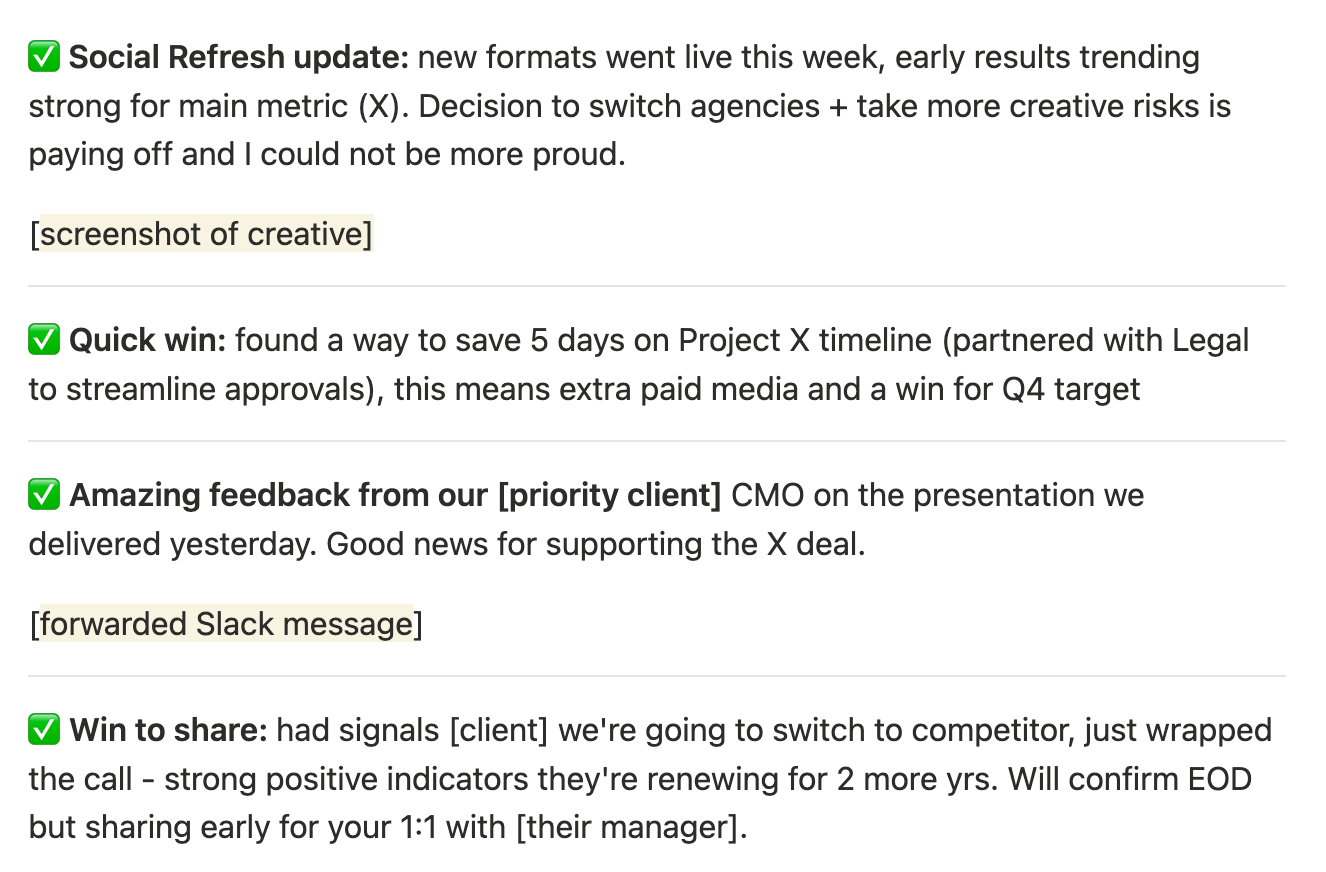
Your perspective is completely unique. The slice of business you see, the problems you’re close to. There’s massive value in that. Your strengths... I promise you, there are things you’re better at than most other people. Forget trying to fix every weak spot. Tune in to what you’re good at and dial those to 11.
So, you’re not special and you’re so bloody special. Humility and self-belief. Bush-raised Sybylla from Possum Gully embodies this.

2. Competing is shortsighted (especially with other women)
So many moments in the show you expect the strong female leads to be cruel to each other (competing over the same love interest, a toxic boss), but they go the opposite way.
“I thought you’d be awful”
“Have I disappointed?”
“No you’re amazing”
”You are!”
THIS WAS MY EXACT EXPERIENCE IN CORPORATE.
Times I either felt, or was on the receiving end of, the subtle instinct to compete…
Should I praise my peer in front of that leader, or does that make them more promotable than me? Should I help the new hire ramp faster, or will they be a threat? Should I tell her she smashed it in the meeting, or does she know she always does?
The answer is yes. Praise her. Help her. Tell her.
The long-term value of that relationship outweighs whatever short-term edge the role or the company gives you. Collect high-quality people. Your peer network becomes the thing that matters most the more senior you get. You grow up together. If someone’s competitive with you, try bringing them in first, instead of competing back. There’s a quiet female solidarity that runs deep in the show and that’s been a consistent, invaluable thread across my own career too.

3. Don’t be boring
On my regional marketing calls everyone gave project wraps like this:
Goal → What we did → Results → Learnings
Totally fine format, but most of the room multi-tasked while they clicked through 17 slides.
My favourite thing to do was:
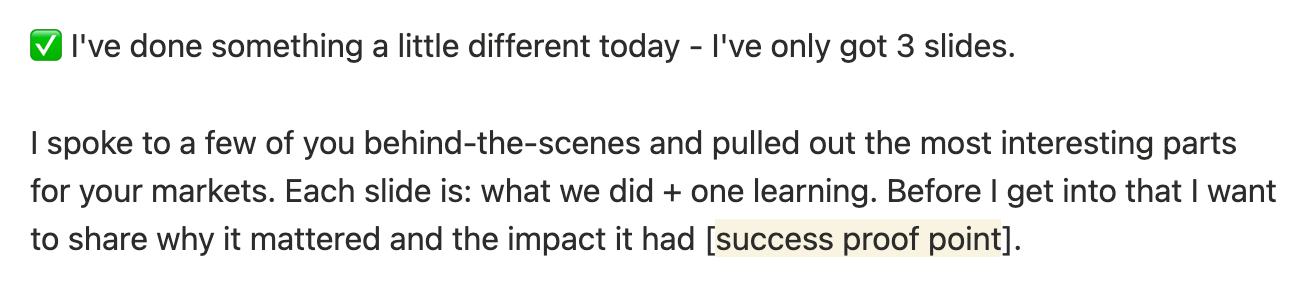
We try so hard to boost our ‘visibility’ but overlook the obvious: being visible means standing out. In our effort to sound professional, we forget we have a personality (especially true of LinkedIn posts).
Best advice: learn storytelling
Sharing “impact” doesn’t need to be as boring as the word is:
What was at stake? What would have happened if you hadn’t done it, or it didn’t work?
Context. “That number might not look big, until you compare it to where we were a year ago.”
Feeling. “This part was pretty special”, “This photo is the moment the website crashed 3 hours before launch and nearly broke our team”.
Things you did that other people wouldn’t have. Talked a client off a ledge. Got told ‘not possible’ then found a way anyway.
You don’t have to actually care about the work (I never really did) but you need to find the parts that were interesting and get selectively excited about those.

(ps I dropped links below for storytelling resources I love)
4. You need elbows and energy
Do you ask for what you want at work? Do you put your hand up for the promo or wait until someone tells you you deserve it? Do you chase the role you really want (pivot to the creative IC) or accept the one betrothed as “your perfect next career step” (the middle manager with a small pay bump)?
I’ve only ever set one career goal: transfer to NYC. I could have done what everyone did - waited for an open role on the internal site, competed with the 20 other Googlers who applied, waited for my manager to help, waited to get lucky.
Instead I reverse-engineered some luck: I needed leaders in the NYC team to experience my work, I pitched 20% time on an unpopular global project, worked insanely hard at 120% for 4 months (half of that living in a shitty hotel in SF and hating my life)… but it worked. I got head-hunted into a New York role and skipped the internal interview process altogether.

That’s a great story of not waiting for permission. Was I always like that? omg no. I almost always waited for my manager to put me forward in a promo cycle. I’ve never asked for a pay rise in my life. I over-delivered until it was handed to me.
When it comes to your career path, try not to be the passenger. Your manager doesn’t really care about your career (they’re too worried about their own). Sybylla doesn’t ask for permission to perform spicy poetry at her Granny’s formal dinner party, but when it comes to the thing that matters most, writing her own story, she does.
Hard-relate Syb.
Same.

5. Unseriousness as a strategy
Humour is a corporate weapon. And if you’re not naturally funny (me), being able to laugh at yourself or the insanity of the situation is just as effective. My favourite, most memorable work moments were born in the trenches of the worst projects. It’s all so stupid. And kind of beautiful when it’s shared.

Love Soph & Sybylla
PS - storytelling links I mentioned 🤍
PS - I wrote this Substack with my voice using this dictation tool I’m in love with. As a three-finger typer it genuinely changed my life (affiliate link, but I’d still recommend it to you even if it wasn’t).
Oof this was so good. I think that “don’t be boring” is SUCH a smart piece of business/career advice. You need to be interesting and have opinions to stand out!
A really hard lesson to learn is the over delivering, never asking for a pay rise, waiting for all the evidence to show why you deserve the promotion - it literally doesn’t pay to go stealth mode!