



Not learning to be direct will hold you back in your career.
You don’t want a reputation as agreeable. I learnt that the hard way.
You don’t want a reputation as difficult either. I watched other (talented) people learn that the hard way.
The difference often comes down to (1) how much you’ve considered someone else’s perspective before delivering the directness, and (2) the words you choose.
You can be direct and liked
“Don’t worry about being liked. Just be respected.”
It’s not bad advice but the problem is: when you’ve been conditioned your entire life (by parents, your culture, your life experiences) to be likeable, it feels like “just get a personality transplant.”
But you can be direct and still widely liked.
It starts with mindset.
Things that helped rewire my brain
Being indirect is time-expensive. As you get more senior, you can’t afford it.
Your value is in your POV. If you can't disagree and defend it, you become less valuable.
Directness is about clarity for the other person. Unclear = unkind.
Not all conversations will feel good, and that’s ok.
Small communication upgrades that make a massive difference
Tell people what you need
Invite yourself to be direct
Share your intention
Use “different” to disagree
Make it about the work
Ask before you challenge
Start direct, end warm
Swap words that undermine you
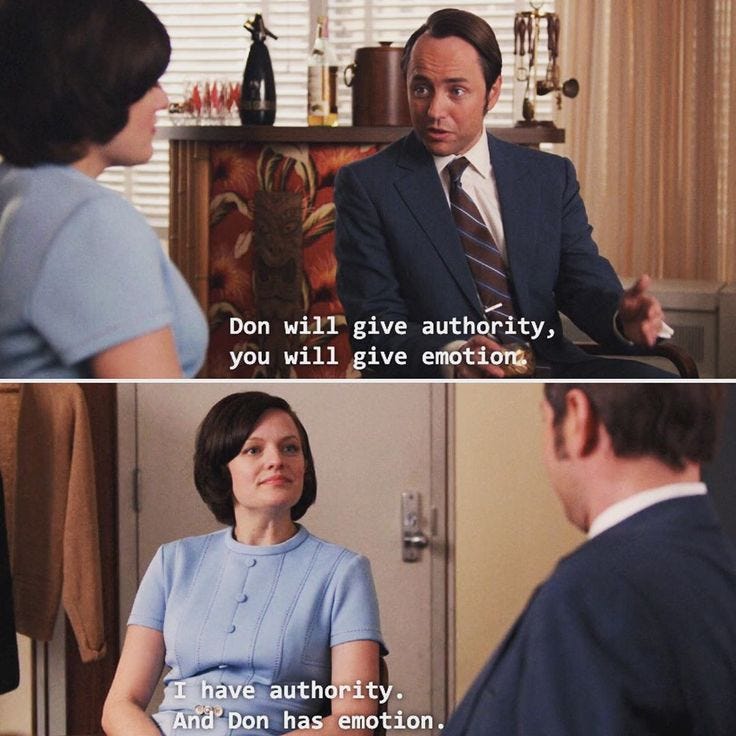
1. Tell people what you need
This can fast-track a lot of conversations.
🚫 Can I get your thoughts on this?
✅ Can I get your directional feedback on whether this fits the brief? I don’t need copy edits right now.
✅ I’m going to share an update on the client. I don’t need you to fix it, I just want coaching on the best way to handle it.
Presenting to senior leaders being explicit is non-negotiable. You can literally put it on the slide.
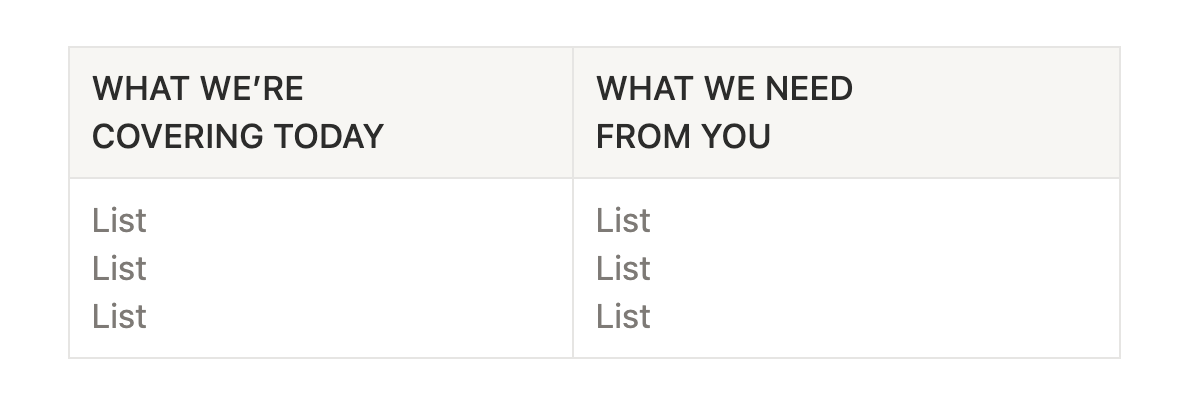
In career conversations the more specific you are, the easier it is for your manager to help you.
I want to work towards [opportunity/skill] in the next 6 months.
→ Here’s what I’m doing now towards that
→ Here’s how I think the company can support
→ Can we map out a plan together?
2. Invite yourself to be direct
You don’t need an invitation, but sometimes it helps. Most people value honesty, dislike sugar-coating, and want people to cut to the chase. Reminding yourself (and them!) of that can make the directness that comes next land more naturally.
✅ I know you value directness, so I’ll get to the point.
✅ I’ll give my honest read because that’s probably the most helpful.
3. Share your intention
When you tell someone why you’re saying something before you say it, they receive it differently (usually better). Start with what you’re trying to make better, then the direct feedback.
✅ I want to help make the argument stronger when we present, so I think this whole section needs to be reworked, etc.
✅ I’m trying to get the scope down so we don’t kill ourselves launching this. This is too many priorities, we need to cut …
For feedback to reports HBR workplace expert Amy Gallo recommends the “intention sandwich” not the compliment sandwich that everyone hates. Great podcast ep on it.
4. Use ‘different’ to disagree
Easy to remember and natural to use. Everyone has a different perspective. You’re not saying they are wrong. You’re saying you see it differently.
✅ I see it slightly differently. I think __.
✅ Can I give a different perspective on this?
✅ We might have different data/context on this. Can I share what I’m seeing?
5. Make it about the work
The most talented people on shared projects push to make it better for the whole group. They care. They anchor in the thing (the brief, the data) not personal opinion.
Who’s the audience for the work?
🚫 I don’t think your copy makes sense
✅ Based on the audience for this being [eg customer/execs], and they [insight], this copy would be confusing.
What’s the goal?
✅ Given the goal for this is [eg sign-ups/speed-to-launch] doing it that way might work against the goal.
What’s worked in the past?
✅ What we’ve seen work well for [similar thing] in the past is X not Y.
6. Ask before you challenge
Part of being direct is being specific. You can be more specific when you have the right context.
🚫 That won’t work
✅ Can you play out how you see that working if XYZ happens?
🚫 I don’t think that’s a good idea
✅ Can you share more on the thinking behind that?
[Then] Thanks, that’s really helpful. The part of that I’d challenge is __.
7. Start direct, end warm
Our default pattern is usually: Soft thing → But → Thing we need to say.
In a lot of cases, you can flip the order.
🚫 Sorry, I know you’re super busy and this is really short notice, but would you mind reviewing this doc today?
✅ Could you please review this doc today? I know it’s short notice. Thank you, it’ll keep the timeline on track.
🚫 I’d love to be involved, thanks for thinking of me! It sounds really interesting! But I don’t have the capacity, sorry…
✅ I don’t have capacity right now. But thank you for thinking of me. It sounds interesting and I’m keen to hear how it goes.
8. Swap words that undermine you
The difference a few words make is genuinely surprising. Just following up on the request. Sorry to bother can you LMK when you have 5 mins to X. This account is a great follow for natural-sounding assertive phrases.
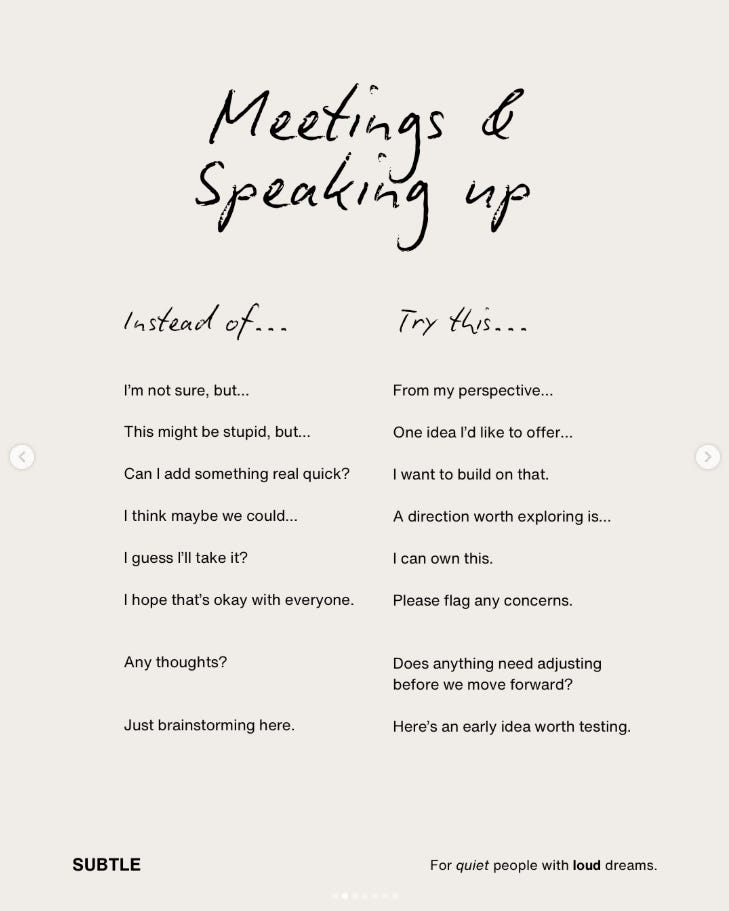
Say it. Don’t say it!
Love Soph ✌🏼
PS - I wrote this Substack with my voice using this dictation tool I’m in love with. As a three-finger typer it genuinely changed my life (affiliate link, but I’d still recommend it to you even if it wasn’t).
Interesting post! For me, directness depends where you learnt to speak.
I get the anglo directness (this post) and why it treats honesty as a risk to be managed so nobody bleeds. I live in the Netherlands (directness = national sport) and grew up in the Balkans and Italy (directness = love language), so I've been fluent in directness for a while but not the kind you described here.
For me, Dutch directness is like neutral weather. You see, in my first Dutch meeting, a colleague told me, in front of everyone, that my plan wouldn't work. Then he asked if I wanted to get lunch. He meant both. That's the thing about Dutch directness: there's no aftertaste. The words are the whole message. Balkan directness, on the other hand, is another animal. It comes with temperature - opinions delivered over coffee, with love, uninvited, at volume. At best it's about intimacy: if my aunt critiques your life choices in forensic detail, congrats...you're family now. We save politeness for strangers. Where I'm from, sugar-coating is what you do to someone you're about to disappoint. Nobody where I'm from has ever had to wonder what their mother-in-law thinks of them.
Which is why 'learn to be direct' undersells the real skill: reading which culture currency the room trades in. The same sentence is efficiency in Amsterdam, aggression in London, and affection in Croatia.
My mom says I've gone Dutch; my Dutch colleagues say I'm a mix of Italian and Balkan; the only thing we've agreed on is my "character" :)
The content was good, but the writing was masterful. I really loved how you organized the ideas and the text on page, making it easy to read the whole thing while keeping me engaged. Thanks!