



“You need to get better at influencing in the moment, in the meeting, on the group thread. Not just letting it play out and then getting your point across later behind the scenes.”
This is exact feedback I got in a performance review.
When you’re not in a position of authority, most influence happens one-to-one. It works. It’s a brilliant skill to learn and one you’ll keep using even when you do have authority.
But there’s a different skill - influencing a group, in the moment, when everyone’s watching. Advocating openly, not just behind the scenes. Speaking up instead of staying silent.
I find this much harder. Most of us do.
What helps is having a few simple influence mini-tools in your kit. These are 7 of my favourite. Bookmark this one :)
1. The Gap technique
Here’s a simple frame that works in a lot of scenarios:
Start with where things are now (pain, problem, what’s not working)
Describe the future state (what’s better?)
Make your recommendation the thing that closes that gap
Scenario: You’re in a planning meeting. You think the team should work with a proper content agency. The room is resistant because it costs money.
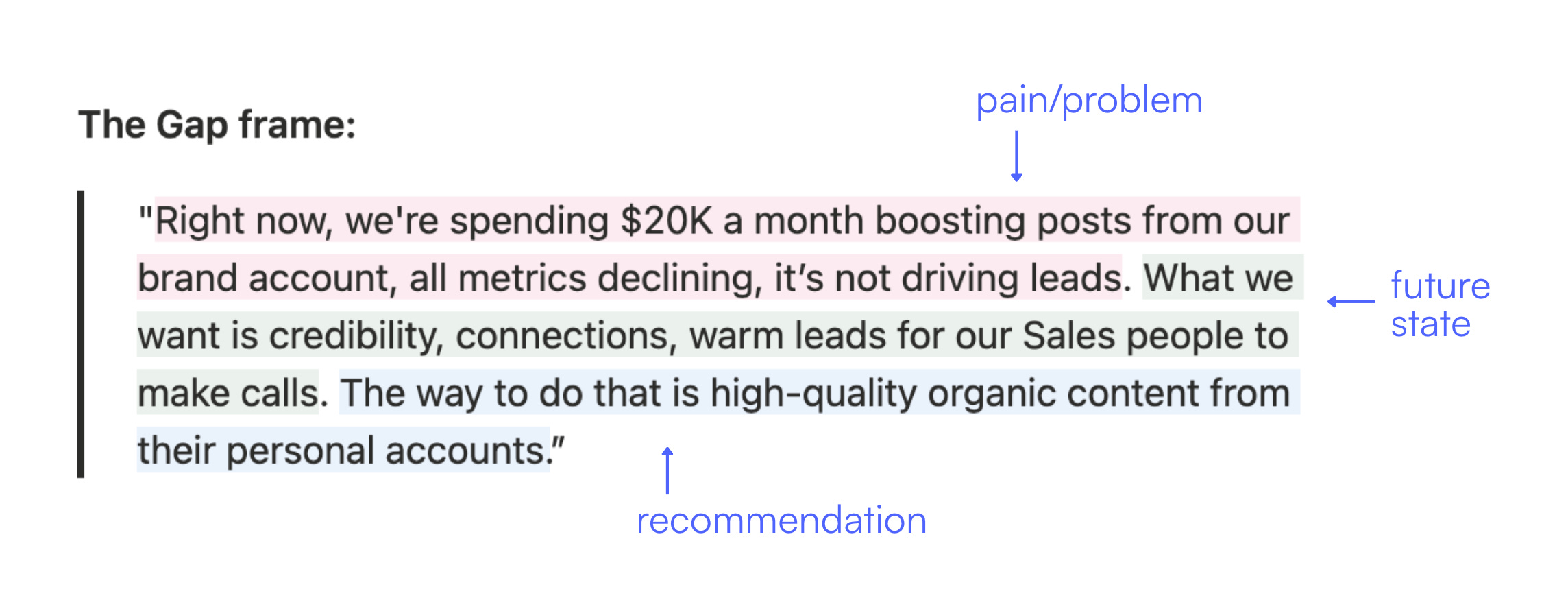
This frame is good when the group gets swirly. Everyone’s stuck debating solution tactics (usually their own), so anchoring back to the problem can open things back up.
What if one team’s pain is caused by another team’s priority? Speak to both. Describe the pain for everyone (this is why it sucks for you, this is why it sucks for us). Show what the trade-off gets everyone in the good state (not doing X, means we do more of Y).
2. Specifics as a trust signal
One of the fastest credibility builders you have is specificity. It shows you’ve actually dug in. You understand the problem, not just giving a personal opinion. This is where early-career people can shine.
In ‘Made to Stick’ (an iconic read!) there’s a concept called Concreteness. It’s the idea that our brains latch onto specific, tangible things more easily than abstract ones. Specificity does that.
Vague statements get thrown around a lot in meetings:
🚫 The approval process is broken - we need to fix it
Being specific is stronger:
✅ Approvals are now taking 40 days, double what it used to be. I looked into the tickets and this is the most common rejection [verbatim quote].
✅ The actual bottleneck is because 3 people need to approve, but one of them is in a different timezone and offline for the first half of our working day.
You don’t always have access to perfect data, but get specific about whatever you can:
Number of steps in a process
Verbatim quotes from customers
Hours wasted
Hours wasted converted into $ dollars
Named specifics: the document, the meeting, the person
Edge case examples people never see
Even arming yourself with one concrete piece of evidence before you walk in can totally change the way people listen.
3. The bridge phrase
When you feel the conversation moving towards a conclusion but you think it should be something else, the hardest moment is feeling like you’re stopping the train. It helps to have a natural, bridging phrase: acknowledge → redirect.

I like:
✅ I hear where we’re headed. Something I keep coming back to is X.
It’s thoughtful. You’re not just reacting.
I also use:
✅ Some good points here. Can I offer a different perspective?
✅ I’m with us on this part ___. I want to push back on this part ___.
Then you can be direct in your point:
✅ I recommend we do [thing] because [your logic]. From where I sit, it’s the right approach because [benefit].
4. Pre-empt the MOO
We have an instinct to avoid mentioning the weak spots when we’re advocating for something. But if you raise the main objection yourself first, you get to own it and show you’ve done the thinking.
Wes Kao calls this the “MOO” Most Obvious Objection. You don’t need to call out every possible objection, but being on the front foot with the main one is good.
Example
✅ The main thing I’ll call out with this approach is timeline, it’s longer than what we scoped. There’s a faster path which we modelled as well, but that means re-doing this whole process again in 12 months. Weighing that up, the slower path is actually better.
One place this gets easier: pre-alignment. If you’ve had 1:1s with the key decision-makers beforehand, you already know what they’re worried about. You walk in knowing the MOO before the meeting starts.
5. Social proof

There’s a famous hotel towel experiment where they got people to reuse their towels with this card:
“Most people reuse their towels at least once during their stay”.
Which was (sadly) much more effective than the environmental message.
People look to what other similar people do in similar situations. I used this a lot at Google to help people feel more comfortable with the decisions we were making.
Examples:
✅ The X team tried this, here’s what they saw…
✅ I spoke to [senior person], they had a similar case and went this direction because…
It’s genuinely helpful when you bring in examples of past precedent, success/fail stories from other teams, markets, a competitor etc. They’re easy to remember in the moment too.
6. Ask → adapt
We get so consumed thinking about our point, we forget the power of a good question. Ask to understand → then use that to adapt the way you position your rec. It’s one of the least adversarial ways to shift a room.
Examples:
✅ What are we/you optimising for?
✅ What are some of the constraints we’re/you’re working with?
✅ What would need to be true for this approach to work?
7. Don’t cave at the first pushback
I find this so hard. Disagreeing in a group meeting needs its whole own Substack post (if you’re good at it, hit reply I’d love to hear your advice). I’m a WIP on this but a few things that help:
Sometimes it’s new information and they’re right. Sometimes you don’t know. Sometimes you know they’re wrong. The pressure feels hard in the moment. My cave almost always happens in the first second of silence.
Try to slow your response:
✅ Give me a second to process that.
✅ I need to think it through. Can I come back on this one?
If you want to push back:
✅ I hear that. I’m not sure it changes the underlying rationale - can I walk you through why?
Using these mini-tools assumes you’ve done the behind-the-scenes work to form a good recommendation in the first place like pre-aligning, understanding cross-team priorities, thinking strategically. When you have, these framing and phrasing techniques are v.v.helpful.
Love Soph ✌🏼
PS - I wrote this Substack with my voice using this dictation tool I’m in love with. As a three-finger typer it genuinely changed my life (affiliate link, but I’d still recommend it to you even if it wasn’t).
Great piece, thank you!
This can be a problem for so many and I'm glad to see it discussed. As an introvert, I had to train myself to battle so many instincts to cave and succumb under the weight of the cumulative attention.
On #7 in particular, I used to have a partner that loved thrift shopping but she hated to negotiate so she always made me do it. It ended up reflecting in her work conversations where she struggled with those silences. Maybe that's a good way to practice in a low-stakes environment, go negotiate a better deal at a yard sale. When they make an offer sit in the silence for a bit and see what happens.